

Events : 8-Mar-2019
· Context: Addressed L&T employees
Events : 8-Mar-2019
· Context: Addressed L&T employees

Looking back at where we came from and where we stand today, it’s truly fascinating!
There was a time when trade meant traversing vast continents on foot, braving harsh terrains, and risking lives and goods to connect with distant lands. Merchants on the Silk Route faced bandits, unfamiliar cultures, and relentless challenges. Yet, their determination bore fruit—they returned home enriched, not just economically but also with stories, knowledge, and connections that shaped civilizations.
Now, the landscape of commerce has shifted entirely. Sitting comfortably in my chair, I can browse, click, and order almost anything from across the globe. A few days of waiting is all it takes for the item to arrive safely at my doorstep. It’s efficient, convenient, and astonishingly seamless.
But this hyper-connectivity comes at a cost—we miss the human touch. Transactions today often lack the face-to-face exchanges that once fostered relationships, trust, and shared experiences. Perhaps, in our race for convenience, we’ve left behind the essence of connection.

A constant complaint from parents is that their children don’t listen to them or show interest in studies. But if we dig a little deeper, we often find that the stress and tension accumulated at the office find their way home. And who bears the brunt? The children.
This is compounded by the heavy expectations we place on them. Whatever we struggle to master at work, we want our kids to excel in effortlessly. I recall attending a parent-teacher meeting where a father of a 6-year-old requested the school to start a German language course. His reasoning? He worked for a German-based company and envisioned his son acquiring the language early to secure a future in the same firm.
Perhaps it's time to pause. Let the kids play, explore, and learn at their own pace. Childhood is a journey, not a sprint toward adult goals.
Quiz time: why does the painting appear incomplete with the color spillage?
This article studies the organizational behavior, it is implication, how HR contributes towards OB, and a detail study of an OB model.
Organizational behavior or OB in short, is about studying the interaction and dynamics of individuals, groups and the entire organization in an organizational setup.
Some of the interests to know about individuals are how a person is motivated, what is their personality, ability to learn new things, his/her interaction in the group.
Teamwork, communication style, leadership, decision-making, conflict resolution are few aspects of interest in a group.
An organizational culture, hierarchy, efficiency and satisfaction are few topics to highlight the organizational dynamics.
Only after understanding the challenges faced by the organization and individuals, a trainer can effectively device a training program to address the concerns.
By knowing the motivating factors of the people, trainer can engage with modules that address different learning styles and personalities. That Paves way to better knowledge retention and implementation.
Knowing group behavior helps the trainer to guide people towards effective team building, conflict resolution, better communication. This ensure a collaborative environment.
OB is influenced at individual, group and organization levels.
Individual
Group
Organization
HR takes an important role of setting up a work environment that brings smoothness to individual, group and organizational goals.
HR ensures increasing productivity, collaboration and employee satisfaction. This is possible by optimal settings of OB.
Recruiting the right person, giving required training, introducing the organizational culture are part of HR activities.
HR mediates any workplace conflicts or misunderstandings. Here again the spirit of OB is retained.
Initiatives like stress management workshops, counseling services, and wellness programs improve overall employee morale and reduce absenteeism.
To summarize, HR bridges the organizational goals with individual capabilities. OB concepts are applied by HR to achieve optimal output and employee satisfaction.
The following are five major models of OB.
Let us explore the System model. It is a modern approach were organizational goals and employee needs are met in a harmonious manner. Trust, collaboration, and personal growth are integral to success.
The needs are people can be classified under physical, emotional, social and intellectual. A framework need to address these needs and provide scope for growth. At the same time, investing in these areas ought to be aligned with the organizational goals. This approach would lead to a positive working environment.
Here are the take away from this module.
My wife noticed that I behaved in a calm manner compared to 2 months earlier. We were going through the activities that might have caused this change. One interesting thing is, I didn't do yoga in these 2 months. So, yoga is ruled out.
We had started a prayer practice in this duration. Four of us sing some hymns and share stories. That practice might have induced a peaceful mindset. Feels good to see some intangible changes in a short period. As I am exploring concepts on inner peace, this transformation is encouraging and motivating to take further steps.
I wrote this article on anima. In that, I made this statement.
I’ve observed instances where I found a woman unattractive at first, but over time, through conversations and shared experiences, I began to see her as beautiful or appealing.
Now, I got a proof for that. Robert Zajong had said this before.


The towering spire of the temple, the gopura, stands tall and proud, its intricate carvings visible from miles away. Its most striking feature is its ability to announce the temple’s presence long before one sets foot in the town. This architectural marvel serves not just as a beacon but as a symbolic guide. Even before we step into the sanctum sanctorum, the gopura invites us to glimpse the divine, manifest in the artistry and grandeur of its outer form.
There’s a deeper meaning here. In our quest for inner divinity, the journey often begins with external signs—a kind word, a moment of clarity, or an overwhelming sense of peace. These subtle markers guide us inward, preparing our hearts and minds for the sacred connection within. This concept resonated deeply with me when I painted my first canvas, capturing the essence of a gopura. It was between 1996 and 1998, during my time in Bangalore—a period marked by creative exploration and introspection.
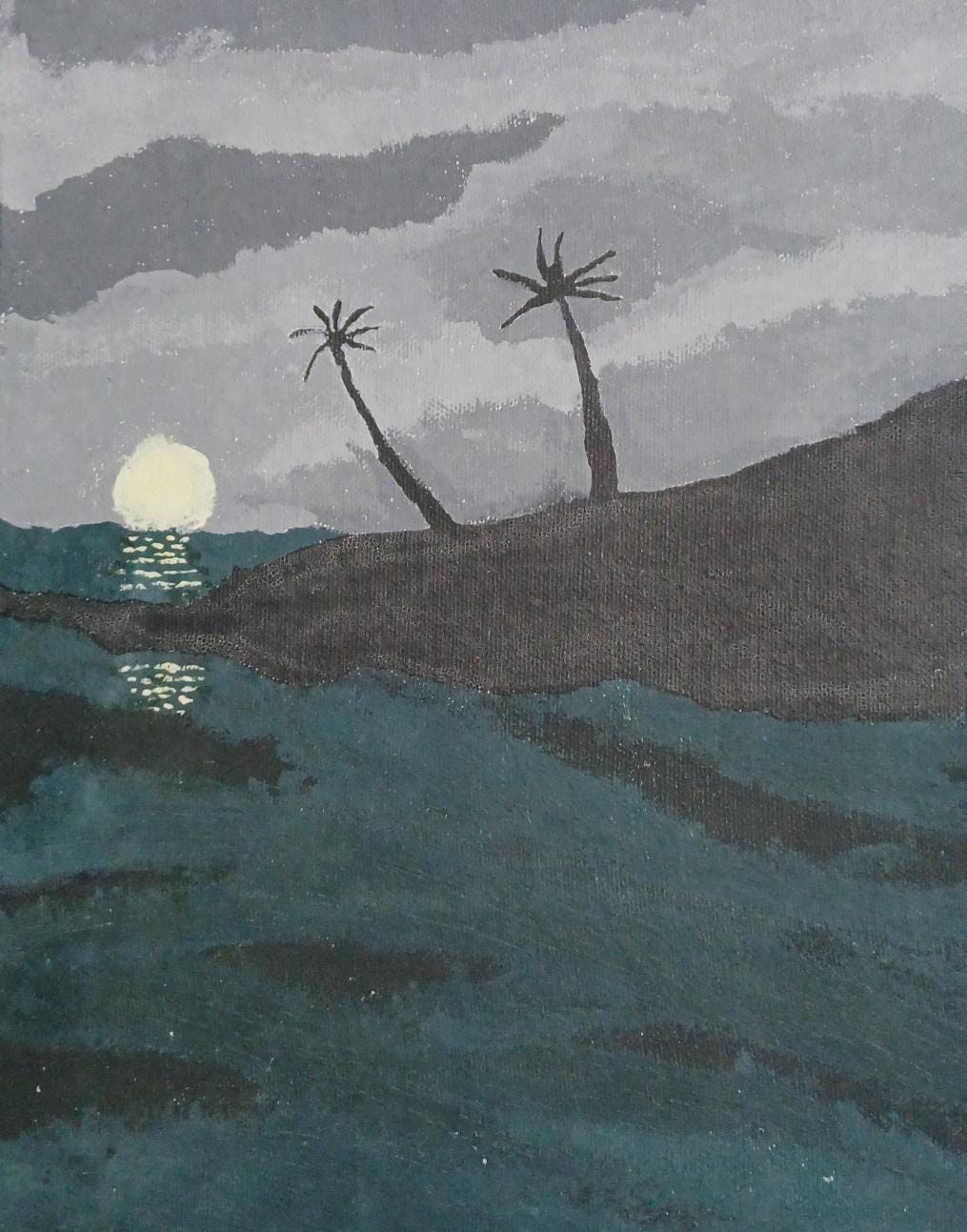
Back in 1998, when I was living in Bangalore, I often found myself captivated by the beauty of nature. One evening, as the sun dipped below the horizon, I sketched the silhouette of coconut trees against the vibrant hues of the sunset. The tranquility of that moment stayed with me, but it also sparked a curious thought—what becomes of the beach once we leave? Do the waves still hum their endless lullaby, or does the shore grow silent in our absence? Does the night bring new stories, even without an audience?
One night, bathed in the soft glow of moonlight, a thought struck me—what if I returned to that very spot? Would the coconut trees look as majestic as they did at sunset, or would the moonlight cast a different spell? Driven by this whim, I revisited the place. Under the silvery beams of the moon, the scene transformed entirely. The same trees, now cloaked in a gentle, ethereal light, stood as silent witnesses to the dance of shadows. That became my second image—a contrast between the fiery farewell of the sun and the serene embrace of the moon.

If you're preparing for an exam, this course could be a game-changer for you. It offers practical tips to enhance your preparation, helps you anticipate potential challenges, and provides effective strategies for managing stress. Additionally, it delves into the power of subconscious preparation, enabling you to approach exams with greater confidence. Take a look and make the most of it when needed!

Why are some men loyal while others stray? When I first pondered this question, I turned to ChatGPT for an exploration of the reasons behind male promiscuity. The responses spanned various fields—evolutionary biology, cultural norms, social psychology, and more. Each provided valuable insights into why some men might be more inclined toward promiscuity than others. However, my curiosity led me deeper, to a less conventional but psychologically rich framework: Jung's concept of the anima.
Before delving into how the anima might play a role in such behaviors, let’s first address some common critiques and misunderstandings around this theory.
The anima is a concept introduced by Carl Jung in the early to mid-20th century, most notably expanded upon in the 1950s. According to Jung, every man carries within his unconscious mind a feminine image—his anima. This inner feminine manifests as a collection of traits and potentials traditionally associated with "feminine" qualities, such as emotional receptivity, intuition, creativity, and sensitivity. Jung believed that the anima acts as a guide between the conscious mind and the deeper layers of the psyche, influencing how a man relates to women and even how he relates to his own inner life.
No, the anima is not considered a scientifically validated concept in contemporary psychology. While Jung's theories have been influential, they also face significant critiques. Many modern approaches have sought to improve upon or deviate from Jung's ideas, such as:
Despite these valid critiques and alternative frameworks, I find the Jungian theory compelling for its simplicity and symbolic depth, offering a way to relate my personal experiences to a broader psychological framework.
Jung posited that a man's relationship with his anima affects how he projects this inner feminine onto the women in his life. The anima can be clear and well-integrated or fragmented and hazy, and this internal state influences how a man relates to others.
When a man's anima is integrated and well-defined, he is more likely to exhibit qualities such as loyalty, emotional stability, and the capacity for deep commitment. In this case, his anima serves as a mature inner guide, helping him focus his desires on a single partner, often leading to monogamous relationships. Love, care, and emotional connection become central themes in his romantic life because the anima is not merely an unconscious force but an integrated aspect of his personality.
For such a man, the anima acts as a source of emotional depth, enabling him to engage in meaningful relationships. His clarity about what he seeks in a partner allows him to project his inner feminine onto one person, rather than scattering his projections across many. This integration fosters a sense of wholeness in his relationships, where he seeks not just physical attraction but also emotional and spiritual connection.
In contrast, a man who engages in promiscuous behavior may have an anima that is fragmented or unclear. In Jungian terms, this means his anima is less integrated into his conscious self, creating inner confusion and restlessness. The lack of a clear anima image leads to a tendency to project the anima onto multiple women, as though he is seeking different aspects of his own inner feminine in each partner. This can result in a pattern of seeking novelty and sensation, rather than deeper emotional fulfillment.
The hazy anima may compel the promiscuous man to constantly pursue new partners, as he is unconsciously searching for an ideal that remains elusive. His relationships may lack emotional depth or permanence because he is not fully aware of what he seeks. The anima, in this case, operates at a more primitive level, closer to Jung's archetype of the temptress or seductress, where the unconscious motivations are driven by the pursuit of pleasure rather than genuine connection.
It’s important to clarify that this doesn’t imply such a man is entirely without control or responsibility. Rather, his unconscious projections may lead him to see potential in many different women, blurring the line between infatuation and true attraction. The anima's unresolved state makes it difficult for him to form lasting attachments because each new encounter feels like a potential fulfillment of an inner longing that remains undefined.
On a personal note, I’ve observed instances where I found a woman unattractive at first, but over time, through conversations and shared experiences, I began to see her as beautiful or appealing. This shift could relate to the anima's dynamic nature, where initial projections may change as one’s understanding deepens. It suggests that the anima is not static; it evolves with the individual, shaped by experiences and conscious reflections.
(Refer Mere exposure phenomena)
While this discussion has focused on the anima in men, a similar process occurs with the animus in women, which represents their inner masculine qualities. Just as the anima can influence a man's behavior in relationships, the animus can shape a woman's approach to romantic and personal dynamics. The principles of projection, integration, and the search for inner balance apply to both the anima and animus, though the specific qualities they embody may differ.
Jung's concept of the anima provides a symbolic framework for understanding why some men exhibit loyalty while others pursue multiple partners. It suggests that our inner psychological landscape, shaped by the integration or fragmentation of the anima, influences how we relate to others in the external world. While the anima theory is not without its critics and is not considered scientifically validated, it offers rich insights into the symbolic and unconscious aspects of human behavior.
Understanding and integrating the anima can help foster emotional balance, creativity, and deeper connections, guiding individuals toward a more holistic sense of self. Whether through loyalty or promiscuity, our behaviors often reflect the state of our inner world—a world where the anima plays a subtle but powerful role.



When we think about farmland, most of us would get the picture of a landlord in pure white and white traditional dress, holding an umbrella and supervising scores of workers in the field. Gone are those good old days. Now workers had migrated towards city for better job, in whatever betterment that is.
The current landlords are different. They wear dirty khaki clothes, may be bare chested and plough in the muddy field. Farm operations are labour consuming, requires lots of man power. In order to resolve the issue, the land owners team up. They form a group of about 5 and combined effort. They usually meet once in a week, put their effort in one of their land. Round robin method is attempted.
Synergy wins.
Like all kids, Varsha kicks, cries and smiles.
Like all fathers, I feel her kicks, cries and smiles are unique and special.


Today I thought of going out for a stroll. Didn't want to go for the long route, instead walked into near by area. That is the place I had been many times. It is a road winding down in the hilly area into a bunch of houses and a temple. Usually we go to the temple and return back. Never seen anything further. This morning I found that the road was cleared further after the temple. There was a road.
Walking through the road, I found many more houses that side, which were out of sight earlier. Further I went into the woods. Saw a group of peacocks, some six of them. Quiet a near sighting. While watching the peacocks, someone else was standing by and watching. It was a mongoose! When I saw it ran away.
A thrilling way to start the day.
Looks like Science is in the right path towards human imagination. Whatever we could think about, technology pounce on that and makes it possible.
The selective memory erasure I blogged about is feasible, it seems.


The revenge of the nomad
Chapter 3. Retreat
Ramraj slowly healed out of the trauma. Took months for him to move around. All emotional feelings had died away from him. He became analytical and view his life from different perspective. He realized someone with muscle power is going to dominate. At the same time, he can sharpen his intellect to overcome the physical forces.
With that in mind, he schemed a master plan. As a first step, he wanted to eliminate Mr Rao's right hand, Das. Das is the brain of Mr Rao. Rao consults him for all activities and executes his task thru Das.
Ramraj started to observe Das's routine. Instead of trying to bring down Das by himself, Ramraj was passing the information to Rao's arch-rival. Weak moments of Das were studied and on a chosen day, men surrounded Das to hack him down.
The arch-rival, Mr Valliesh, was happy to hear about this. As per his estimate, Mr Rao would soon fall apart from his business empire.
Mr Rao was also analyzing the events. He happen to know that Ramraj had helped Valliesh.
Ramraj expecting trouble, travelled to a far place.

End of chapter 3 out of 7.
To be continued.

