Showing posts with label art. Show all posts

Monday, December 09, 2024

Johari window


This is the art I loved doing. It has elements of our inner  world and how best we can interact with outside circle. 

The Johari Window is a psychological framework that helps individuals understand themselves and improve their relationships with others. Developed by psychologists Joseph Luft and Harrington Ingham in 1955, this model uses a simple 2x2 grid to represent aspects of self-awareness and mutual understanding. It is often used in counseling, team-building, and self-improvement exercises.

The Four Quadrants

  1. Open Area (Arena):
    This quadrant represents information about yourself that is known both to you and to others. Examples include your strengths, behaviors, or preferences that you openly share. Expanding this area enhances trust and communication.

  2. Blind Spot:
    Here lies information about you that others see but you are unaware of. It may include habits or traits you don’t recognize in yourself. Feedback from others can reduce this area and help with personal growth.

  3. Hidden Area (Façade):
    This quadrant includes things you know about yourself but choose not to reveal to others, such as private thoughts, fears, or insecurities. Sharing these selectively can foster deeper connections.

  4. Unknown Area:
    This contains information unknown to both you and others—hidden potential, subconscious behaviors, or undiscovered talents. Exploration through introspection or new experiences can bring elements of this area to light.

The Johari Window is dynamic; the quadrants shift in size based on self-disclosure, feedback, and self-discovery. It's a practical tool for enhancing self-awareness, empathy, and communication, particularly in personal development or team settings.

As you uncover and diminish the last three quarters, the open arena will expand. That is a desirable situation.

Wednesday, December 04, 2024

The Traffic


Traffic jams are a universal frustration, and they often lead us to question the necessity of commuting, especially when our jobs can be performed remotely. Why does the modern workplace insist on hybrid or in-person modes when the alternative—working from home—is clearly more efficient and stress-free for many?

Navigating the chaos of traffic, with its suffocating fumes and relentless honking, is a taxing ordeal. It takes only one snap of road rage to make an already unpleasant experience worse. Contrast this with the serenity of starting your day at home: waking up at your own pace, easing into work mode without the rush, and connecting remotely in a calm, focused environment.

From an employer's perspective, however, the insistence on in-office work often stems from the belief that physical presence fosters collaboration and enhances productivity. Additionally, a significant concern is moonlighting—some employees exploiting remote setups to juggle multiple jobs. Unfortunately, the actions of a few result in policies that affect everyone.

As technology evolves, let’s hope for solutions that balance flexibility with accountability. May remote work flourish in a way that boosts productivity and trust, ensuring that humanity and fairness prevail in the workplace.

Tuesday, December 03, 2024

Reflections on Maslow's Theory


Maslow's hierarchy of needs offers a fascinating perspective on human growth and progression. It highlights how we ascend from addressing basic survival needs to pursuing self-actualization. My personal experience with this theory has been both challenging and enlightening.

In the mid of 2024, around 1800+ employees were mass laid off from my past company. I was among those affected, and the economic downturn made finding a new job incredibly challenging. Initially, I was consumed by anxiety—haunted by fears of depleting my savings, the shame of unemployment, and the uncertainty of what lay ahead. These worries loomed large, leaving me feeling restless and deeply unsettled.

Gradually, I returned to the present moment. I took stock of my skills and interests, which provided a sense of direction, albeit unclear at first. Among the few options I identified, I explored a couple of them with hope and determination. While the destination remains distant, I feel confident in my ability to navigate this journey.

This phase of uncertainty also forced me to confront deeper questions about identity. Without the label of a job or career, I felt adrift and incomplete. It was an uncomfortable but necessary part of my growth, as it pushed me to redefine who I am beyond external roles.

It is not only me! My teenage daughter was disturbed too. “Dad! I had told all my friends that you are a software developer. I can’t change that. So, you please find a job in the software industry,” she said, her words a mix of concern and pressure, reflecting how my situation impacted those around me.

One profound realization during this journey is that striving for higher goals often diminishes the weight of lower-level worries. By focusing on growth and purpose, I found a sense of fulfillment and resilience that transformed my experience of this challenging time.

Tuesday, November 26, 2024

Silk Route


Looking back at where we came from and where we stand today, it’s truly fascinating!  


There was a time when trade meant traversing vast continents on foot, braving harsh terrains, and risking lives and goods to connect with distant lands. Merchants on the Silk Route faced bandits, unfamiliar cultures, and relentless challenges. Yet, their determination bore fruit—they returned home enriched, not just economically but also with stories, knowledge, and connections that shaped civilizations.  


Now, the landscape of commerce has shifted entirely. Sitting comfortably in my chair, I can browse, click, and order almost anything from across the globe. A few days of waiting is all it takes for the item to arrive safely at my doorstep. It’s efficient, convenient, and astonishingly seamless.  


But this hyper-connectivity comes at a cost—we miss the human touch. Transactions today often lack the face-to-face exchanges that once fostered relationships, trust, and shared experiences. Perhaps, in our race for convenience, we’ve left behind the essence of connection.


The Shift


A constant complaint from parents is that their children don’t listen to them or show interest in studies. But if we dig a little deeper, we often find that the stress and tension accumulated at the office find their way home. And who bears the brunt? The children.


This is compounded by the heavy expectations we place on them. Whatever we struggle to master at work, we want our kids to excel in effortlessly. I recall attending a parent-teacher meeting where a father of a 6-year-old requested the school to start a German language course. His reasoning? He worked for a German-based company and envisioned his son acquiring the language early to secure a future in the same firm.


Perhaps it's time to pause. Let the kids play, explore, and learn at their own pace. Childhood is a journey, not a sprint toward adult goals.


Quiz time: why does the painting appear incomplete with the color spillage?

Saturday, November 16, 2024

The Gopura

The towering spire of the temple, the gopura, stands tall and proud, its intricate carvings visible from miles away. Its most striking feature is its ability to announce the temple’s presence long before one sets foot in the town. This architectural marvel serves not just as a beacon but as a symbolic guide. Even before we step into the sanctum sanctorum, the gopura invites us to glimpse the divine, manifest in the artistry and grandeur of its outer form.


There’s a deeper meaning here. In our quest for inner divinity, the journey often begins with external signs—a kind word, a moment of clarity, or an overwhelming sense of peace. These subtle markers guide us inward, preparing our hearts and minds for the sacred connection within. This concept resonated deeply with me when I painted my first canvas, capturing the essence of a gopura. It was between 1996 and 1998, during my time in Bangalore—a period marked by creative exploration and introspection.

Friday, November 15, 2024

Day and Night


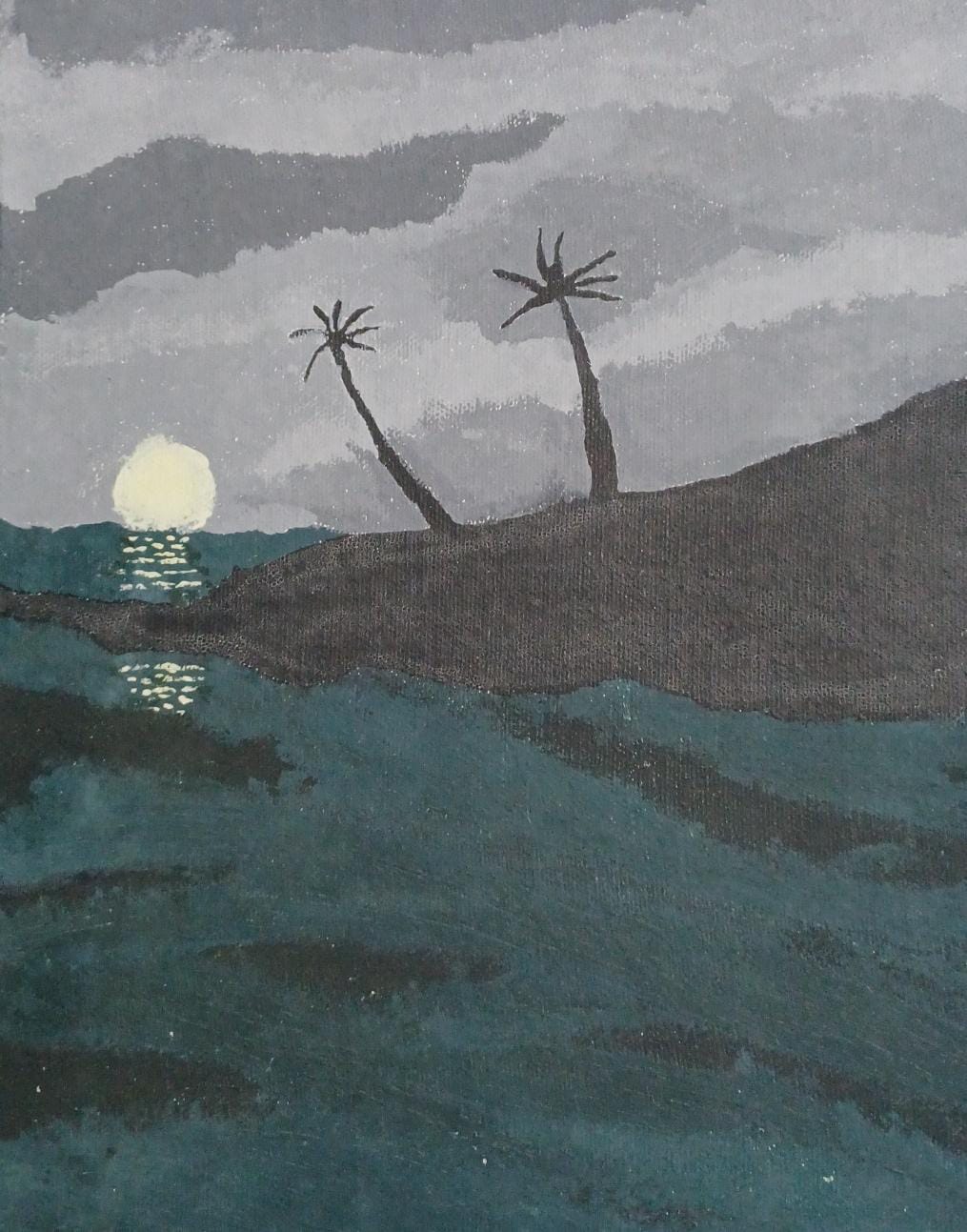
Back in 1998, when I was living in Bangalore, I often found myself captivated by the beauty of nature. One evening, as the sun dipped below the horizon, I sketched the silhouette of coconut trees against the vibrant hues of the sunset. The tranquility of that moment stayed with me, but it also sparked a curious thought—what becomes of the beach once we leave? Do the waves still hum their endless lullaby, or does the shore grow silent in our absence? Does the night bring new stories, even without an audience?

One night, bathed in the soft glow of moonlight, a thought struck me—what if I returned to that very spot? Would the coconut trees look as majestic as they did at sunset, or would the moonlight cast a different spell? Driven by this whim, I revisited the place. Under the silvery beams of the moon, the scene transformed entirely. The same trees, now cloaked in a gentle, ethereal light, stood as silent witnesses to the dance of shadows. That became my second image—a contrast between the fiery farewell of the sun and the serene embrace of the moon.


Wednesday, October 23, 2024

The Promiscuous Man: A Jungian Perspective


Why are some men loyal while others stray? When I first pondered this question, I turned to ChatGPT for an exploration of the reasons behind male promiscuity. The responses spanned various fields—evolutionary biology, cultural norms, social psychology, and more. Each provided valuable insights into why some men might be more inclined toward promiscuity than others. However, my curiosity led me deeper, to a less conventional but psychologically rich framework: Jung's concept of the anima.


Before delving into how the anima might play a role in such behaviors, let’s first address some common critiques and misunderstandings around this theory.


Understanding the Anima


What is the Anima?  

The anima is a concept introduced by Carl Jung in the early to mid-20th century, most notably expanded upon in the 1950s. According to Jung, every man carries within his unconscious mind a feminine image—his anima. This inner feminine manifests as a collection of traits and potentials traditionally associated with "feminine" qualities, such as emotional receptivity, intuition, creativity, and sensitivity. Jung believed that the anima acts as a guide between the conscious mind and the deeper layers of the psyche, influencing how a man relates to women and even how he relates to his own inner life.


Is the Anima Scientific?  

No, the anima is not considered a scientifically validated concept in contemporary psychology. While Jung's theories have been influential, they also face significant critiques. Many modern approaches have sought to improve upon or deviate from Jung's ideas, such as:

  •  Sandra Bem's androgyny theory, which suggests that individuals embody both masculine and feminine traits, allowing for a more fluid understanding of gender roles.
  •  Gender schema theory, also proposed by Sandra Bem, which argues that gender is socially constructed and learned through cultural norms rather than being an inherent archetype.
  •  Raewyn Connell’s work on hegemonic masculinity, which introduces the idea of multiple masculinities and femininities, shaped by social contexts.
  •  Object relations theory, which emphasizes how early relationships with caregivers form internal patterns that influence future behavior.
  •  Queer theory and non-binary perspectives, which challenge the notion of fixed gender identities or inherent traits, promoting a view of gender and sexuality as fluid and socially constructed.


Despite these valid critiques and alternative frameworks, I find the Jungian theory compelling for its simplicity and symbolic depth, offering a way to relate my personal experiences to a broader psychological framework.


The Anima Projected onto Reality

Jung posited that a man's relationship with his anima affects how he projects this inner feminine onto the women in his life. The anima can be clear and well-integrated or fragmented and hazy, and this internal state influences how a man relates to others.


The Loyal Man

When a man's anima is integrated and well-defined, he is more likely to exhibit qualities such as loyalty, emotional stability, and the capacity for deep commitment. In this case, his anima serves as a mature inner guide, helping him focus his desires on a single partner, often leading to monogamous relationships. Love, care, and emotional connection become central themes in his romantic life because the anima is not merely an unconscious force but an integrated aspect of his personality.


For such a man, the anima acts as a source of emotional depth, enabling him to engage in meaningful relationships. His clarity about what he seeks in a partner allows him to project his inner feminine onto one person, rather than scattering his projections across many. This integration fosters a sense of wholeness in his relationships, where he seeks not just physical attraction but also emotional and spiritual connection.


The Promiscuous Man

In contrast, a man who engages in promiscuous behavior may have an anima that is fragmented or unclear. In Jungian terms, this means his anima is less integrated into his conscious self, creating inner confusion and restlessness. The lack of a clear anima image leads to a tendency to project the anima onto multiple women, as though he is seeking different aspects of his own inner feminine in each partner. This can result in a pattern of seeking novelty and sensation, rather than deeper emotional fulfillment.


The hazy anima may compel the promiscuous man to constantly pursue new partners, as he is unconsciously searching for an ideal that remains elusive. His relationships may lack emotional depth or permanence because he is not fully aware of what he seeks. The anima, in this case, operates at a more primitive level, closer to Jung's archetype of the temptress or seductress, where the unconscious motivations are driven by the pursuit of pleasure rather than genuine connection.


It’s important to clarify that this doesn’t imply such a man is entirely without control or responsibility. Rather, his unconscious projections may lead him to see potential in many different women, blurring the line between infatuation and true attraction. The anima's unresolved state makes it difficult for him to form lasting attachments because each new encounter feels like a potential fulfillment of an inner longing that remains undefined.


Personal Reflection

On a personal note, I’ve observed instances where I found a woman unattractive at first, but over time, through conversations and shared experiences, I began to see her as beautiful or appealing. This shift could relate to the anima's dynamic nature, where initial projections may change as one’s understanding deepens. It suggests that the anima is not static; it evolves with the individual, shaped by experiences and conscious reflections.

(Refer Mere exposure phenomena)


Applying Anima Theory to Animus in Women

While this discussion has focused on the anima in men, a similar process occurs with the animus in women, which represents their inner masculine qualities. Just as the anima can influence a man's behavior in relationships, the animus can shape a woman's approach to romantic and personal dynamics. The principles of projection, integration, and the search for inner balance apply to both the anima and animus, though the specific qualities they embody may differ.


Conclusion

Jung's concept of the anima provides a symbolic framework for understanding why some men exhibit loyalty while others pursue multiple partners. It suggests that our inner psychological landscape, shaped by the integration or fragmentation of the anima, influences how we relate to others in the external world. While the anima theory is not without its critics and is not considered scientifically validated, it offers rich insights into the symbolic and unconscious aspects of human behavior.


Understanding and integrating the anima can help foster emotional balance, creativity, and deeper connections, guiding individuals toward a more holistic sense of self. Whether through loyalty or promiscuity, our behaviors often reflect the state of our inner world—a world where the anima plays a subtle but powerful role.


Monday, May 12, 2008

mono color picture

Never thought a mono color could give striking effect. Color image always brings multi-color to our mind.


Here is the drawing I did recently.